
Crazy Train
A Public Finance Discussion With No Mention of Ozzy Osbourne

Large Federal Subsidies (perhaps 75%) for local transportation projects such as Big City rail transit systems and cross-city High Speed Rail create bad incentives as localities are likely to over-spend on projects that are unlikely to pass a cost/benefit test.
When Cities and States can spend “Other People’s Money” on local projects, basic demand curve logic predicts that they will dive in and be quite ambitious as they pursue a whole range of projects. For example, Los Angeles has built out its heavy rail (the Purple Line along Wilshire) and light rail (my Metro E line). Mayors love these projects as they create construction jobs and public transit jobs. Mayors can celebrate their economic multiplier effects and their impact on reducing local air pollution and local GHG emissions. These latter calculations hinge on the assumption that the riders of the new shiny public transit would have driven if this new transit option hadn’t been invested in. This claim is false. Most of the rail transit riders are former bus riders. See our 2005 paper.
In my joint research with Nate Baum-Snow, we documented that the ridership of new rail transit projects over the last 50 years has been quite low in most cities with the exception of Washington DC.
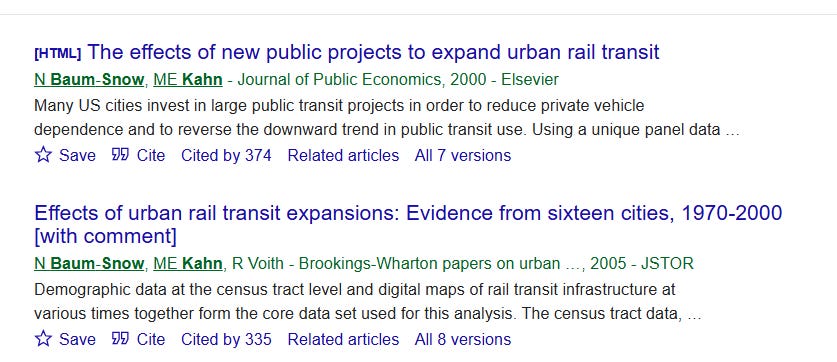
Why? Public transit is slow and it takes you downtown. In most Metro Areas, people do not want to go downtown. They live in the suburbs and work in the suburbs. See my paper with Jordan and Ed.

In the case of Big City transit, ex-post analysis of ridership systematically documents that ridership counts are much lower than what was predicted by project boosters before the project was implemented. I discuss this point in this Substack.
In this Substack, I want to discuss my findings from my 2014 paper with Matthew Holian.
Here is the Back Story.
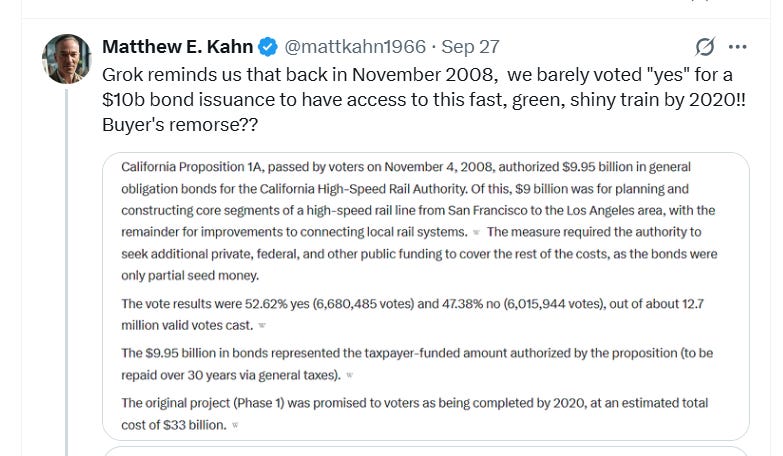
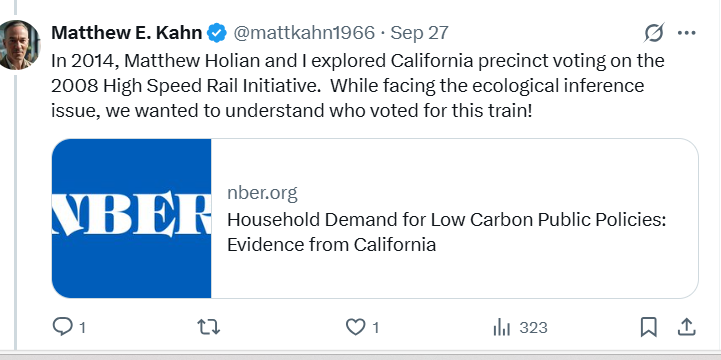
Matt and I created two different California data sets. At the Census Tract level, we collected data on voting on Prop 1A in 2008 and we merged in year 2000 Census data to know each census tract’s demographics (such as % White, % college graduate, Distance to the City center, % Republican Registered voters, % homeowners). We also had access to the PPIC Survey Data in October 2008 where roughly 2000 survey respondents reported their intentions about voting for the initiative that would sell bonds to pay for the train.
In hindsight, the key points to note above is that the voters were promised a relatively low priced train that would be completed by 2020. This promise has not been kept!
Matt and I used basic linear regression models and we reported research tables such as this one;
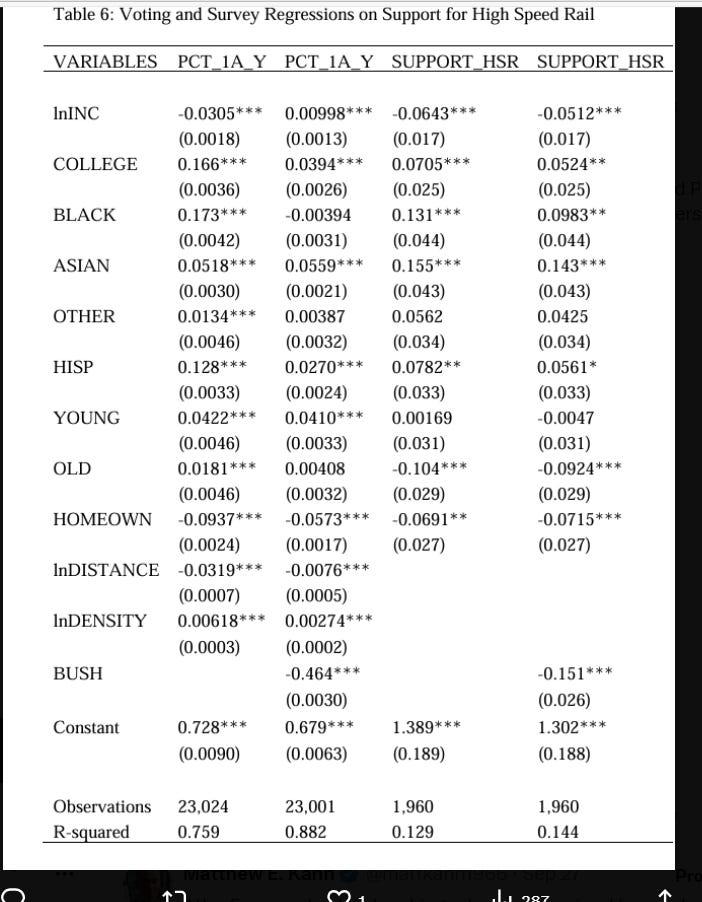
I interpret our results as saying that back in 2008 that Republican, Republican homeowners who lived further from California Cities were less likely to support this train. More educated people were more likely to support the construction of what turned out to be a “crazy train”.
The key “what if” here pertains to what the vote on Prop 1A in 2008 would have been if the people of California had received a smaller Federal Subsidy? I claim that we wouldn’t be in this mess right now if the subsidy had been 0% or 20%. The people of California would have sobered up and given more thought to this vote if we had more “skin in the game”.
Mayors, City Councils and senior City employees work downtown. I suspect a bias by City leadership in thinking that all people who are relevant to them experience things as they do. If you live and work in the suburbs you are simply irrelevant.