

This has been a hot summer. We know that the poor are exposed to more heat and have fewer protection strategies to avoid the heat. My Los Angeles has opened public cooling centers and has arranged for transport to help people get to such centers.
This is a sensitive topic but I do think it is important to highlight some key economics points and to raise some slightly philosophical issues about personal freedom and choice.
Suppose that Matthew is poor and I rent an old housing unit in my city. I work as an outdoor worker. I want us to think about my daily heat exposure on hot summer days in my city. To keep this Substack short, let’s ignore the question of why I choose this city rather than moving to a cool city close to the Canadian border.
Rental Housing
My motivation for writing this column is based on this 2025 Federal Reserve of Philadelphia report.
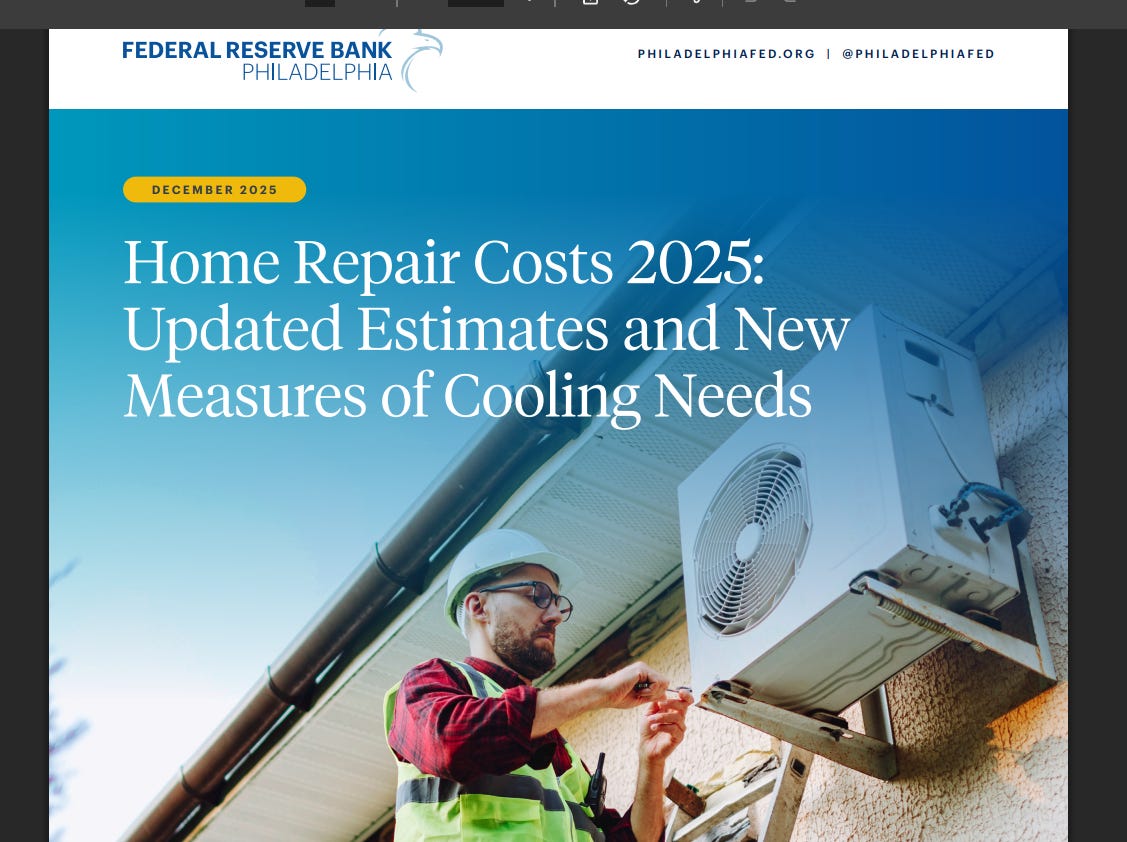
The researchers use micro data from a recent American Housing Survey and they use a key question in the survey where respondents were asked; “Was your housing unit really hot last year?”. They then use other questions in the AHS to know the physical attributes of the building and the apartment. These use these data to approach a 3rd party company who engages in home repairs to ask what would be the $ expenditure necessary to offer good air conditioning for the building.
Here is the report’s bottom line. See the 3rd bullet point below.
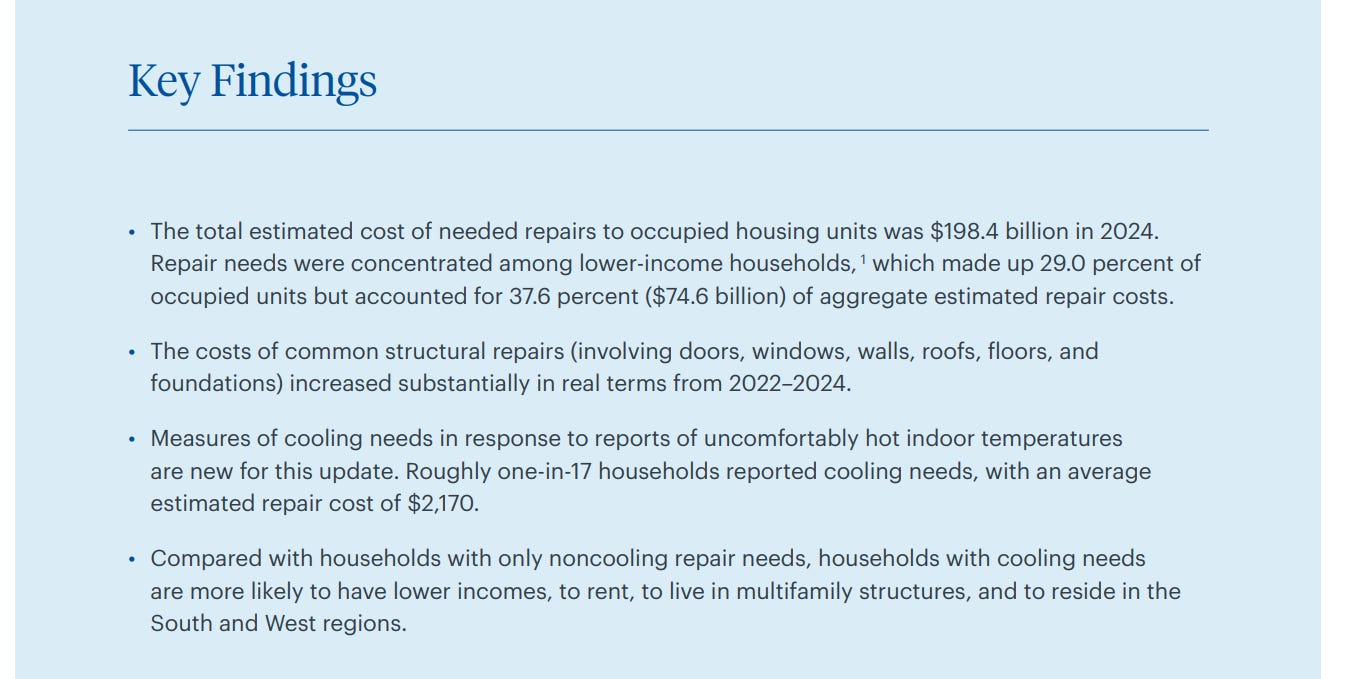
As Kahn the Economist, I have the following reaction. The renter of these badly air conditioned units are not “passive victims”. They pay less in rent because the unit is of lower quality. The equilibrium theory of real estate is that price reflects quality. Poor people have less money to spend on rent and they choose to live in lower quality housing and one dimension of quality is worse air conditioning.
Since the tenant’s rent is lower, they can spend their “saved $” on other goods or buy a fan or other cooling equipment. Such individuals can offset their heat exposure along many margins.
Now, I am making an assumption here. I am assuming that the poor person who rents this apartment is aware of how heat affects them in the short term and the medium term and they are aware that their apartment is hot. If the housing market is competitive, then the apartment owner will have to offer them lower rents (relative to other apartments with better quality) to lure them to rent and remain there. This is the revealed preference argument.
It takes “two to tango”. The owner of the badly air conditioned apartment unit has chosen not to make the upfront investment to upgrade the unit. This owner must reason that the renters don’t value the cooling benefits by enough to make it profitable for the owner to do so!
NOW it would interest me concerning how many of the poor renters live in public housing. Does public housing feature more units that are too hot? The public sector doesn’t respond to market competition because the demand for public housing exceeds the supply of such units (rents are really low for public housing).
The economic logic of heat exposure is that people choose and they are free to Choose whether they rent a cheap badly air conditioned unit (that they can then upgrade) or they rent a more expensive, higher quality unit. They are adults and make their own choices facing their budget constraint (I.e knowing their total income and market prices).
Now let’s turn to total income.
Matthew’s total income = wage*hours worked + Government transfers
Let’s ignore taxes.
Suppose that outdoor work pays more relative to Matthew’s other labor market options. Outdoor work in a hot summer play will pay a wage premium (this is the logic of compensating Differentials). Matthew may be attracted to such a job if he thinks he can handle the heat.
So, Matthew may choose to rent a poorly air conditioned apartment and then work in an outdoor job. THE American Housing Survey does NOT report the home occupant’s industry and occupation. This means that there is no data set that indicates the joint residential and occupational choices of lower income people.
So, if Matthew lives in a badly air conditioned place and then works outside in a hot city; no researcher could observe this for a large national sample given our current data bases.
My philosophical question for you is; Is Matthew a rational decision maker here? Does he have the freedom to choose his heat exposure? If Matthew’s income increases, he is likely to take more proactive steps to reduce his heat exposure.
This ties back to a major theme in my research. Economic growth facilitates adaptation to environmental risks.
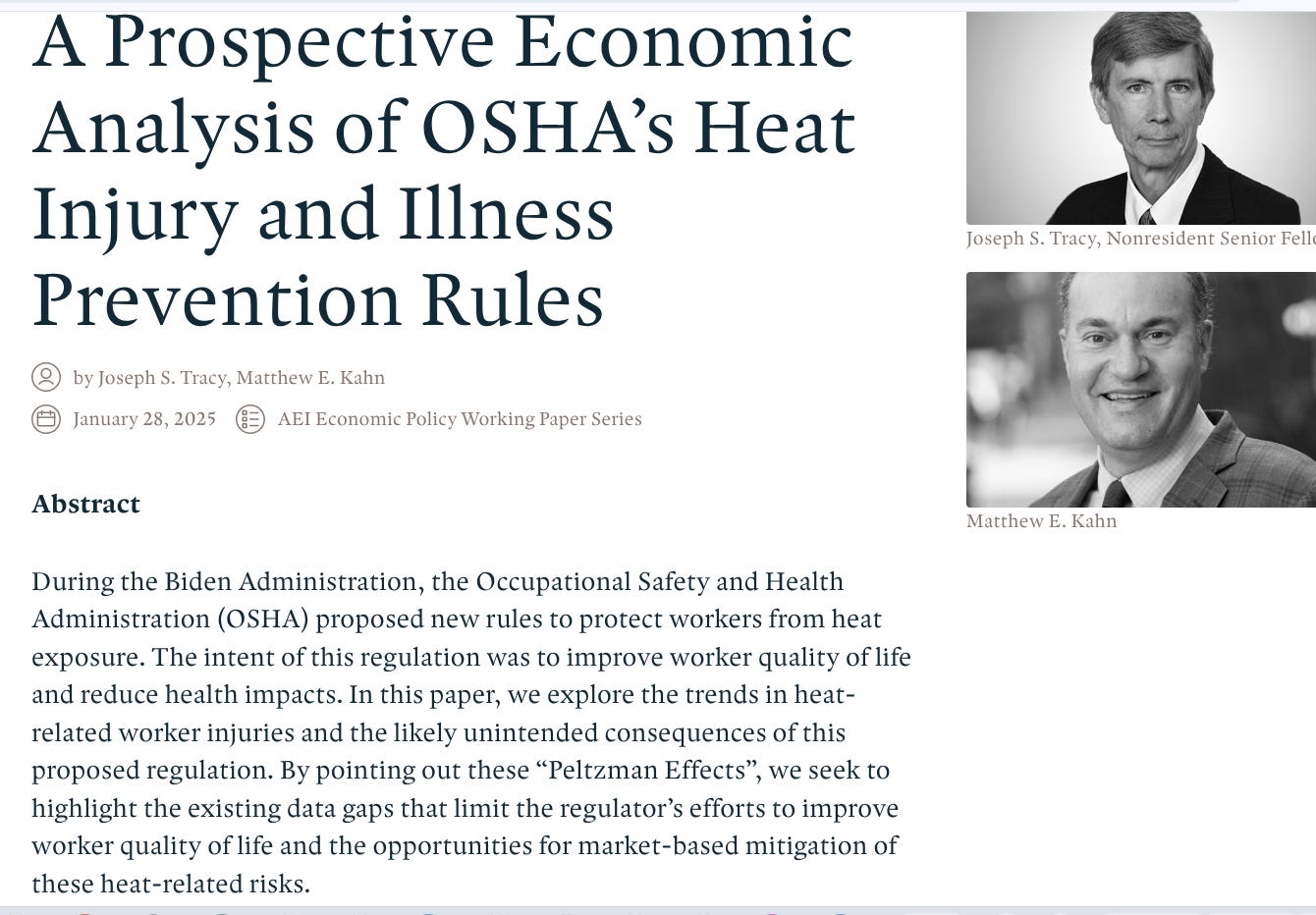
At least in the labor market, I do not believe that government OSHA regulation will protect workers such as Mathew. Have you read our 2025 paper?
The key data I would like to see is to use a randomized payment $ design to enroll poor, middle class and rich people to wear a FitBit to record their 15 minute temperature exposure where they are over the course of a week and to use geocodes on them to establish what was the outdoor temperature where they were versus their actual temperature exposure based on their body functions. Across the income spectrum, who is able to face less heat and how do they achieve this?