
Geoengineering Efforts Will Confront the Arrow Impossibility (and the Coase) Theorem

As a graduate of the University of Chicago, I receive very few emails from my alma mater about sports achievements but I do receive many research updates. This profile of a Post-Doc’s new research is directly related to my research.
Here is a video of her speaking about her work and its economic implications.
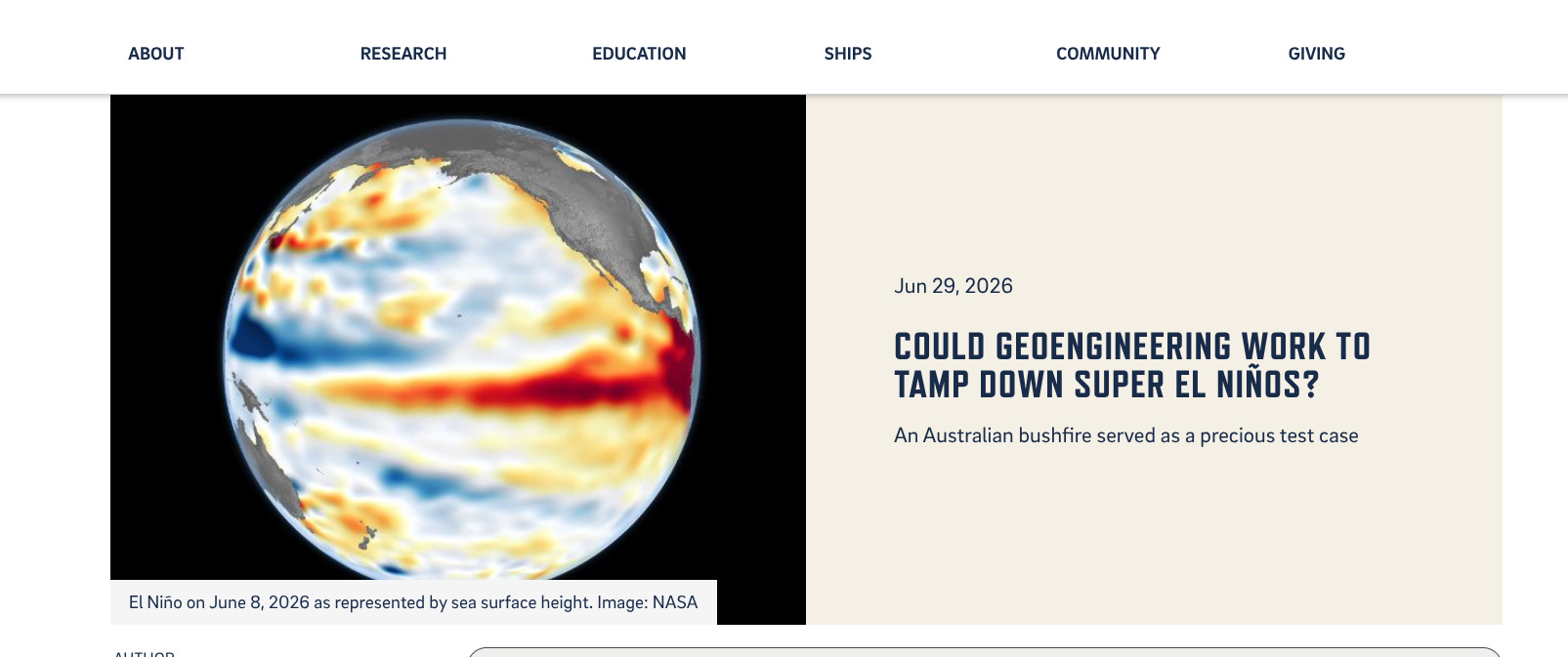
She is using natural experiments in our recent past and her understanding of physical processes to explore whether there are relatively low cost strategies to reduce the variability caused by El Nino weather events. Here is a short video where she discusses her work.
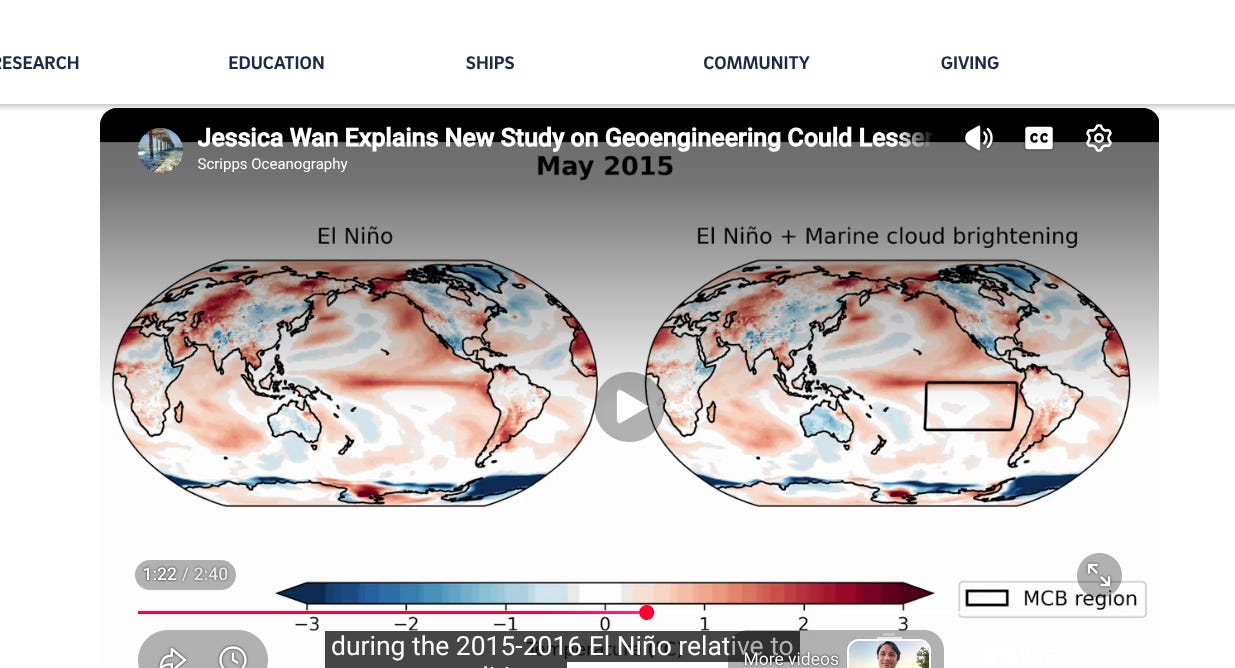
Here is an image from her talk where she highlights the spatial variation in outcomes if there is an El Nino event and we have implemented Marine cloud brightening (the geoengineering intervention)
What I want to focus on are the LOSERS from reducing the volatility of this stochastic process. Many investors and firms have made sunk investments because they anticipate these cycles and assumed that “Man” would not play God and intervene in these processes.
Let me say upfront, that I can be convinced that this geoengineering intervention in AGGREGATE is a win for the global economy. I want to focus on the losers here and what is their right to compensation. Do they have the property rights to not have geoengineering imposed on them? If the world implements geoengineering without compensating them, then this is a form of a takings. This is my Coase Theorem point.
Turning to Ken Arrow and the Arrow Impossibility Theorem; if the world voted on this geoengineering proposal would a majority of the world’s people (or nations) vote for it? This depends on the spatial distribution of the expected post-Geo Engineering treatment effects (and any credible side payments). In a big world, where people disagree about their priorities, what is “good public policy”? Arrow teaches us that this is a very difficult question and can’t be decided by majority vote.
Grok wrote out a long list of who loses from her proposed intervention.
“Who Loses from This Geoengineering
Imagine scientists successfully dim a developing super El Niño with marine cloud brightening. Global damages fall. Yet the same intervention quietly creates a new set of losers—people whose incomes, costs, or portfolios move in the wrong direction even when their own skies stay clear. Here is how the losses land on four groups.
Producers
Some producers lose because the weather itself turns against them. If the intervention weakens the atmospheric conditions that normally quiet the Atlantic during El Niño years, stronger hurricanes become more likely along the U.S. East Coast from Florida through the Carolinas, across the Gulf Coast from Texas to the Florida Panhandle, and throughout the Caribbean. Coastal growers, fishers, and processors in those stretches face higher odds of destroyed crops, damaged boats, and flooded facilities.
Other producers lose purely through prices. A classic El Niño often triggers drought in key coffee regions of Central America or Indonesia, shrinking world supply and sending prices soaring. Farmers in Brazil’s Minas Gerais or Colombia’s coffee belt—whose own rainfall is untouched—suddenly harvest a windfall. Suppress the El Niño and that drought never arrives. Supply stays ample, prices stay modest, and those Brazilian and Colombian growers watch the extra revenue evaporate. The same story plays out in soybeans, wheat, or palm oil: any farmer who would have cashed in on someone else’s weather disaster loses when that disaster is prevented.
Consumers
Most shoppers and households gain from steadier supplies and lower prices. A smaller set loses in concrete ways. Families that rely on El Niño’s milder winters for cheaper heating bills in the northern United States and Europe forgo that seasonal break. And if Atlantic storms intensify, residents and businesses from Miami to Charleston and from Houston to New Orleans absorb steeper insurance premiums, higher rebuilding costs after landfall, and temporary spikes in the price of everything from lumber to fresh produce.
Speculators
Commodity desks and hedge funds that load up on contracts expecting the usual El Niño chaos are left holding the bag. Traders who go long coffee, cocoa, or certain grains in anticipation of drought-driven spikes see those spikes cancelled. Others who short products expected to flood the market once production holds steady lose the other side of the bet. The intervention turns a familiar weather trade into a policy trade, transferring money from those who read the climate correctly to those who read the geoengineering correctly—or simply stayed out.
Investors
Capital follows the same paths. Owners of farmland or processing plants in the regions that would have enjoyed scarcity prices watch the value of those assets decline once the scarcity never materializes. Shareholders in Brazilian coffee exporters or Gulf Coast agribusinesses feel the hit in lower earnings and softer stock prices. Insurers and reinsurers with heavy exposure to Florida, the Carolinas, and the Gulf Coast must reprice the higher hurricane risk, eroding the value of their books. Paper losses arrive fast—often before a single extra raindrop or missing raindrop is felt on the ground.
In every case the mechanism is transparent: change the weather in one place and the price system, the insurance market, and the asset market redistribute the consequences to people who never asked for the experiment.”
END of Grok Quote
In a case where the expected discounted global macroeconomic benefits of an intervention are positive but the losses are large and distributed, what happens next? Two Nobel Laureates (Coase and Arrow) have different ideas about the implementation challenge here.
If physical scientists want to improve the world, how will they engage with the political economy issues of implementation here?
On a personal note, this type of interdisciplinary discussion between climate scientists and economists doesn’t really occur. During my time on the faculty at Columbia, UCLA and USC, we don’t have these discussions mainly because the physical scientists aren’t good listeners. The “solutions” are obvious to them and they find social science and people to be messy and confusing. If we sat down and had a meeting, it would turn into a Republican Hate discussion after about 7 minutes.
Good post. Before I retired I taught global warming in my regulation class. https://rasmusen.org/g406/chapters/06-pollution.pdf
It's a great topic for teaching because so many different ideas come in, and so many types of solutions are proposed, as well as the lesson to be skeptical of scientists and how to construct data.
It is also good for bringing in just what you discuss here: how to get the necessary agreement. We can't get agreement on, say, emission quotas. China will not agree; there is a huge free rider problem. Plus, they are too expensive.
We *can* implement geoengineering, though. That's because it can be done cheaply and unilaterally. If Ecuador wants to lower the temperature via putting sulfur dioxide high in the atmosphere, it can afford it and it doesn't need anybody else's agreement. Its only problem is that the losers might send in the marines to conquer Ecuador.
This illustrates the Coase Theorem because in effect Ecuador has the property right. If Canada doesn't like the geoengineering, it can pay Ecuador to stop.
But then the assumptions behind the Coase THeorem kick in. First, Canada must have soldiers to enforce its contract, in which case it might just want to use the soldiers directly and skip the payment. Second, Ecuador is not the only owner of the right to geoengineer. Canada has to pay off Peru and Chile too.
Very stimulating! I might post this on X.