
Lessons from Microsoft's Experiment With Offering Claude Access for Free for Microsoft's Engineers
The Tragedy of the Commons Within a Famous Firm

Economists aren’t fans of charging $0 for scarce goods. Free love, free water and Free AI prompts make us grumpy. Consider the case of Microsoft and its late 2025 policy of offering free Claude access for its engineers.
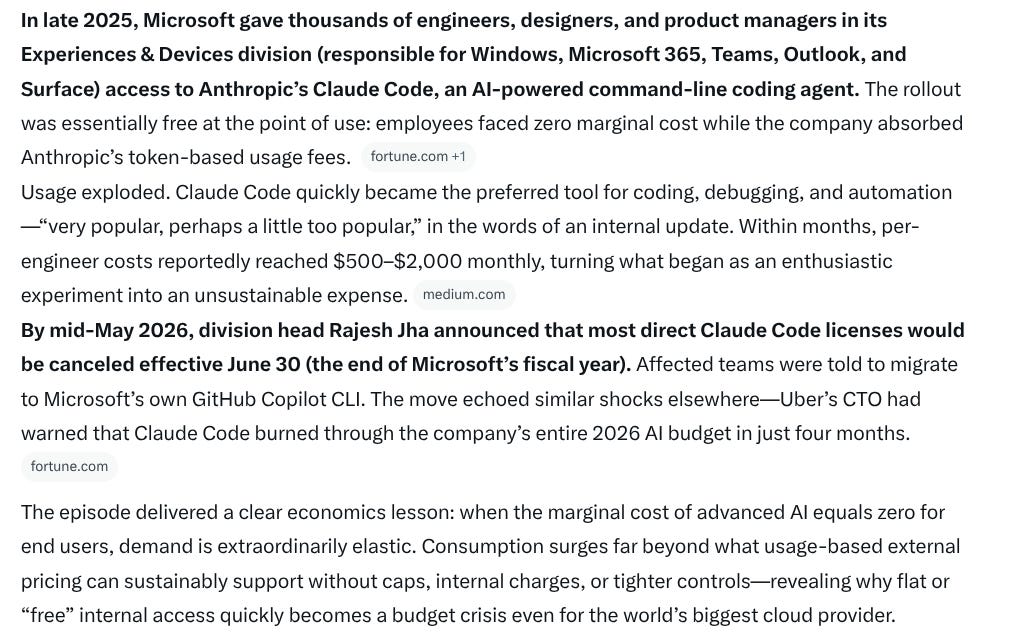
Econ 101 students will recognize that one point on a demand curve was sketched out as the economist at Microsoft can observe the total count of prompts each Microsoft engineer posed when the price was zero.
In aggregate, the demand for the Claude Code exceeded the budget item.
Now, we don’t know what the marginal revenue generated at Microsoft because of the access to the Claude Code at a price of zero.
What I do Know, is that this rationing of access to Claude Code doesn’t make much sense. Microsoft could just charge its engineers the average price it negotiated with Claude. The engineering team could always just pay Claude the market price to use it.
Michael Schwartz is the chief economist at Microsoft and I remember him as a young man when he was a professor at Harvard. I bet that Michael has been asked about optimal firm AI prompt pricing.
Each unit at Microsoft will be charged for the prompts it uses and its profit will be adjusted for this business expense. The manager of each unit will have an incentive to monitor prompt users. Basic economics predicts that this input will be used until
marginal revenue per prompt = marginal cost = internal market price > 0
So under the old rules, the price was zero but under this new rule the prompts will be more efficiently allocated.
Now I recognize that I am assuming that if there are cross-division spillovers that the Coase Theorem holds within the firm. If Unit A’s use of Prompts benefits Unit B, will Unit B reward Unit A for using the prompt?
I claim that moving away from the zero marginal cost incentives encourages this within firm Coasian exploration of maximizing the gains to trade!
So, I am puzzled about what is the optimal price that Microsoft should charge its engineers for using Claude. The price of zero is too low and the market purchase price is likely to be too high (assuming there are synergies taking place within the firm). How could the Chief Economist figure out the optimal AI marginal cost to charge employees?
Update:
My essay here was based on my memory of this 2013 story from the Columbia University Student newspaper.
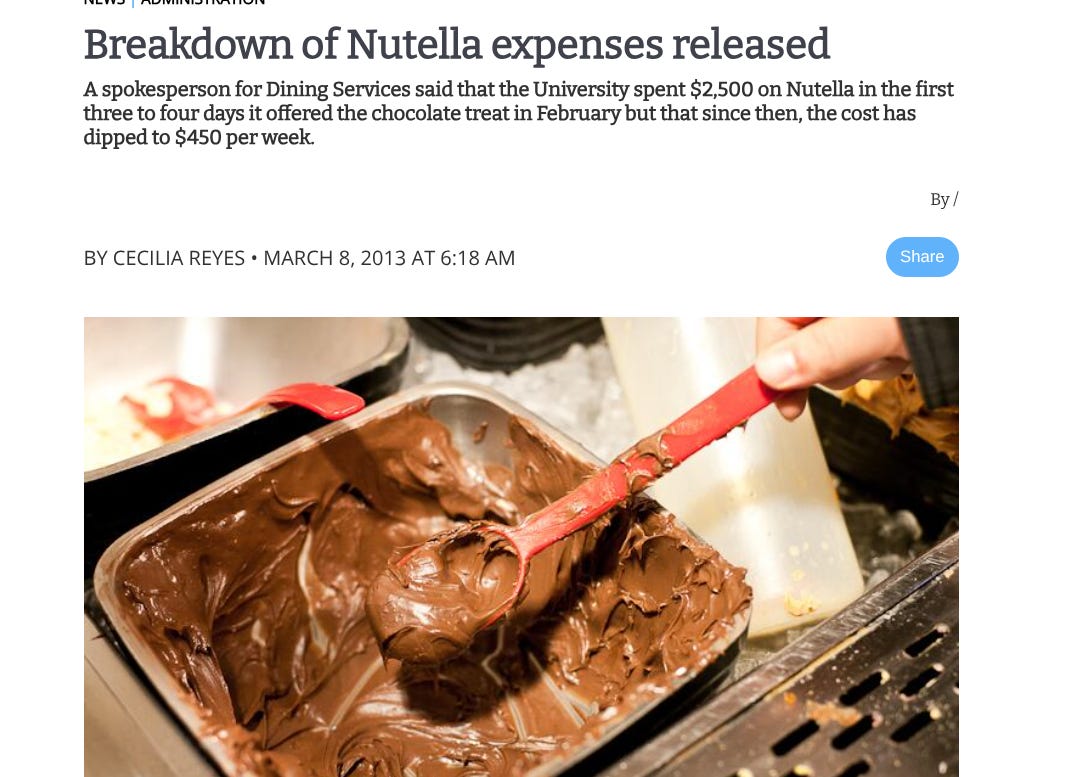
Facing a marginal cost of $0 for Nutella, students demanded many pounds!!