

At roughly the 41-minute mark of this All In Podcast, Elon Musk discusses the economic benefits of colonizing Mars.
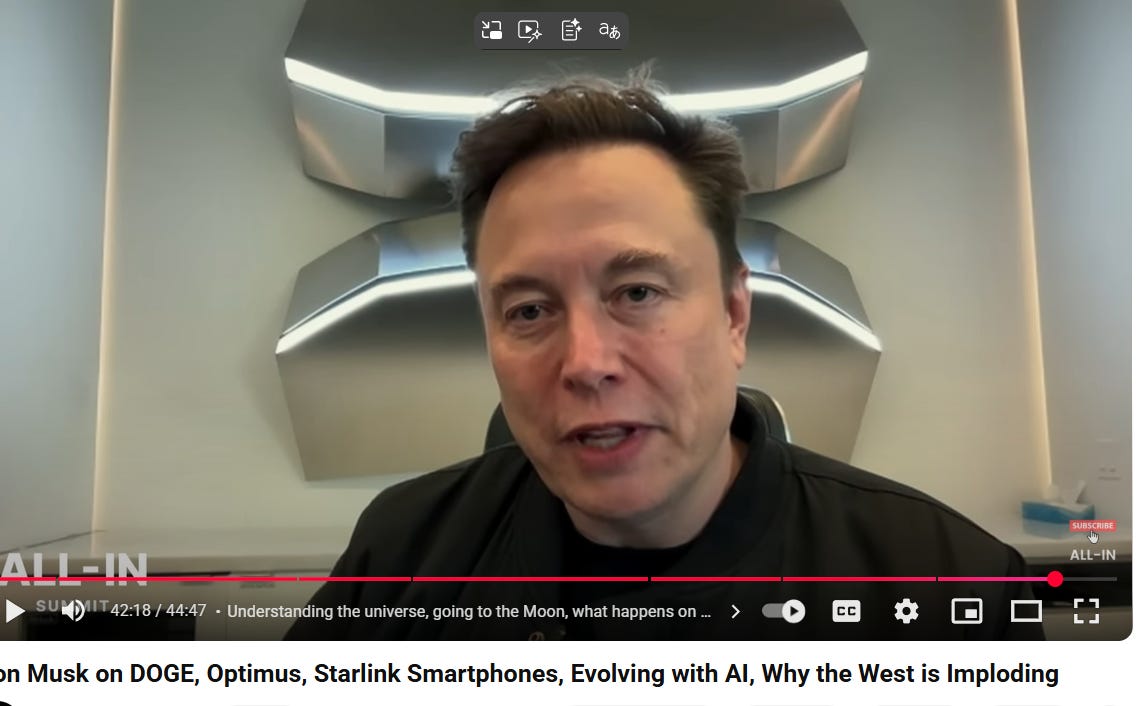
He makes a spatial diversification argument, arguing that the Earth faces existential risks, such as nuclear war and highly contagious viruses. By creating viable alternative societies, humanity reduces our extinction risk by creating migration options to other planets. He is an adaptation optimist! Economists should read Chad Jones’ work on existential risks.
The standard Lucas Critique applies here. As the perceived existential risk increases, people and firms will reoptimize. Fatalists will believe that the end of the world is near and will “party like it’s 1999”! Optimists like Musk will invest in having a credible Plan B and this fuels endogenous innovation that benefits all of us.
An interesting public policy question in this age of industrial policy is whether society should subsidize Musk’s efforts to colonize Mars. If a subsidy increases the probability that his initiative succeeds and is viable sooner, how much does each American value this real option? How could a talented economist measure this? As our value of a statistical life increases, we should be willing to pay more to avoid existential risks!
Here is part of the transcript of Musk’s remarks;
40:23
do think that uh that that there is a fork in the road of human destiny where
40:29
um if we can establish a self-sustaining city on Mars with the the key test being
40:36
if the resupply shifts from Earth stop coming for any reason does Mars continue
40:41
to to prosper or does it die out at the point at which Mars is able to uh
40:46
prosper and grow on its own the probable lifespan of consciousness is dramatically greater.
40:52
because we are no longer dependent on everything going right on Earth. You
40:58
know, there's there's always some possibility of self annihilation on Earth with the World War II or or a supervirus or um or or a meteor like
41:07
extin, you know, that destroyed the dinosaurs. We know from the fossil record that there've been many mass mass extinction events. So uh the question
41:16
that I sort of was wondering about is will civilization will the civilizational arc continue to ascend
41:23
such that we can make Mars self- sustaining before the civil civilizational ark descends
41:30
um because the the window of opportunity to make life multilanetary
41:36
exists now for the first time in the 4 and a half billion year history of earth. Yeah. Elon, let's assume that we get
41:43
there and you're there. Um, you know, you'd be the elder
41:48
statesman. You'd have the moral authority of Mars. How do you run Mars?
41:56
But I just there's this point that I I think I I want to just emphasize again
42:03
that that's that's it's more important than the form of governance on Mars or who's there in the early days. What
42:10
really matters is that Mars um is self-
42:15
sustaining that we are truly a multilanet species and s such that we've
42:20
achieved planetary redundancy so that that if if something and obviously we
42:25
should do everything possible to make sure life on Earth is great but there's always some risk that of an annihilation
42:31
event on Earth. Yeah. Um like I said self annihilation or some natural disaster. Um
42:38
and uh and so the the probable lifespan of consciousness increases dramatically
42:44
as soon as uh as soon as we are multilanet species with the key test
42:49
being can Mars survive if the resupply ships stop coming. So so getting like the first missions to Mars are not that
42:56
important. The what matters is can you get sufficient tonnage tonnage to Mars such that Mars can prosper on its own.
43:04
Um, and that means it has to have all of the ingredients of civilization. It it it's not just that you need to build,
43:09
for example, a chip factory on Mars or ship fab on Mars, but you you need the ability to build.
43:16
Do you do you have a sense of the time scale? Like, let's assume Starship is at a state starting in, you know, 2026.
43:22
Then there's going to be a bunch of testing. Obviously, there's going to be a bunch of early testing. We only have certain launch windows. So, there's a
43:29
bunch of time constraints. Is that is this a 50-year thing in your mind? Is it a 150 year thing? Is it something that
43:35
is for our generation or is it our children's generation? Where do you see that point if it's optimally possible?
43:43
You know, if things go and break our way, um I think it can be done in in 30
43:49
years. Um wow. So if provided there's an exponential increase in the in the
43:55
tonnage to Mars with each successive Mars transfer window, which is every two years. So every two years the the
44:02
planets align and you can you can transfer to Mars. Um, so
44:08
I I think in roughly 15, but maybe as few as 10, but
44:15
10 to 15ish Mars transfer windows. If you're um
44:21
seeing exponential increases in the tonnage to Mars with each Mars transfer window, then it should be possible to
44:27
make Mars self-sustaining um in in about call it roughly 25 years.