

Last night we flew from Jakarta to Singapore. It is interesting to contrast these two cities. While the flight time was only 75 minutes and the weather is basically the same, there are clear differences between “the feel” of the two cities.
I am struck by how quiet and clean is Singapore relative to Jakarta. Jakarta’s non-stop motorbikes makes you feel like you are living in a Jason Bourne Action Movie.
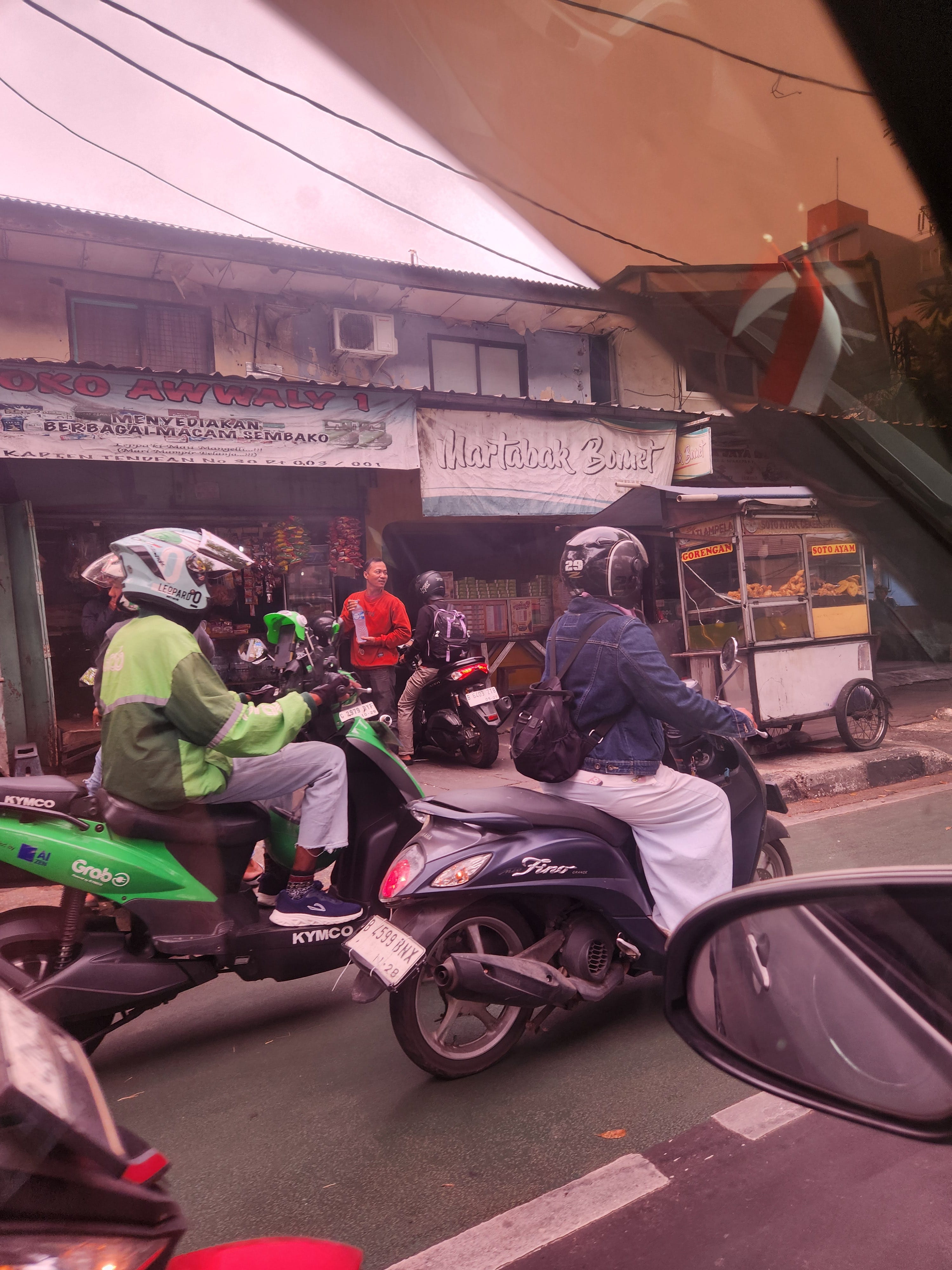
Every car on the road faces a non-stop stream of motorbikes zooming past you on both sides of the car. This processes is both orderly and chaotic.
Lower income people in Jakarta have to be able to move around and the motorbikes are fast and cheap.
Ed, Jordan and I studied this thirty years ago in our U.S work.
Edward L. Glaeser & Matthew E. Kahn & Jordan Rappaport, 2000. "Why Do the Poor Live in Cities?," NBER Working Papers 7636, National Bureau of Economic Research, Inc.
In Jakarta, these bikes are noisy and dirty but they are crucial for providing basic mobility in the city.
Now a fundamental property rights issue arises. Do the owners of the dirty bikes have the right to cause air and noise pollution in the city? If they do, then the rest of the city should consider paying them to reduce their pollution.
If these bike owners don’t have the property right then they should be required to upgrade their equipment to reduce their impact on the Commons. When tens of thousands of Jakarta’s motorbike users face such a “polluter pay’s fee” this would lead some of them to buy an electric motorbike and this would “green the city” and reduce the noise.
I explored these issues 35 years ago in this paper that nobody cites!
Matthew E. Kahn, 1996. "The Efficiency and Equity of Vehicle Emissions Regulation: Evidence from California's Random Audits," Eastern Economic Journal, Eastern Economic Association, vol. 22(4), pages 457-465, Fall.
Now Siqi and I had a very good time in Indonesia. I encourage you to watch our video about our trip here on Youtube.
I find it amazing that policymakers don’t take noise pollution more seriously in the West where a lot of it is an optional luxury bad (motorcycles, modified mufflers, noisy leaf blowers). It’s not like people don’t complain about it. The elite just don’t seem to take it seriously. Probably because they’re rarely outdoors where it occurs.
I agree about major noise pollution and the detrimental impact of polluted air in Jakarta (although the locals don’t seem to bother). The key difference is that Singapore has a super-efficient underground metro line, while Jakarta hasn’t. I read somewhere that their “Trans Jakarta” - a network of buses running over preferential lanes - is the most efficient solution (both in economic and environmental terms) for big cities in middle-income countries. But yet, their transport capacity is quite limited. What do you think?
BTW, electric scooters and cars do run in Jakarta. Using the car/scooter hiring app “Grab”, I was very happy to be able to select this option for both scooters and cars. There was only a minor surcharge. They have a very efficient system to recharge batteries. They basically rent a service allowing drivers to stop at recharge stations and swap a used battery with a fully charged battery. I am pretty sure that electric engines will spread (and some subsidies from the government wouldn’t harm).
It’s kind of funny as I also travelled from Jakarta toward the north. However, I travelled by ship (I have given up flying altogether, to reduce my carbon emissions). It took me 34 hours to reach Singapore from Jakarta. However, I bypassed Jakarta and come directly to Kuala Lumpur. Interestingly, I found no electric car option (and no scooter) in my Grab app here.
BTW, as an economics researcher I am a big fan of your work!