Should OSHA Regulate Worker Heat Exposure?

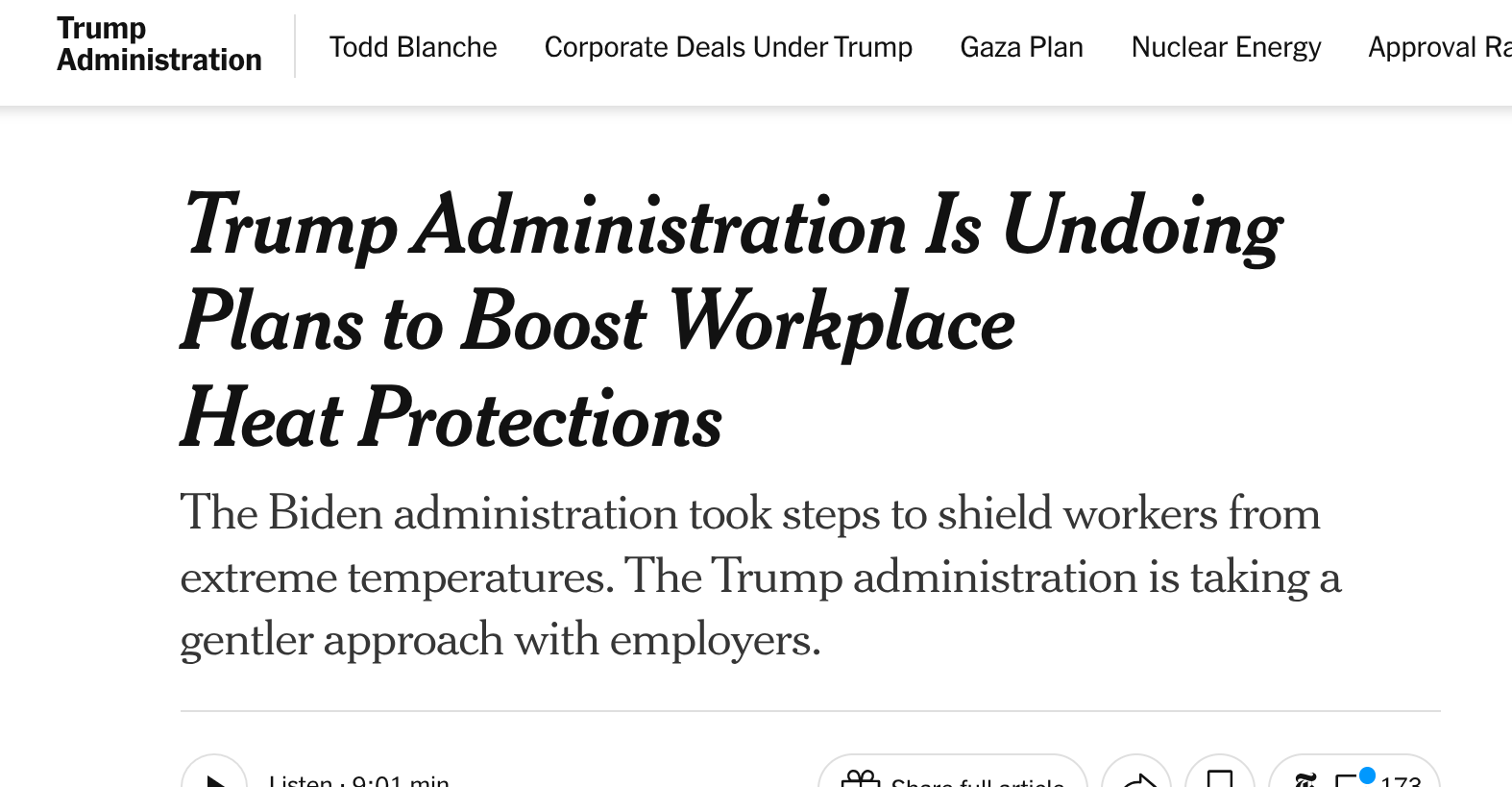
During this hot summer of 2026, millions of workers are being exposed to high heat. The Biden Administration sought to introduce rules to protect such workers. The New York Times reports that the Trump Administration is rolling back those plans.
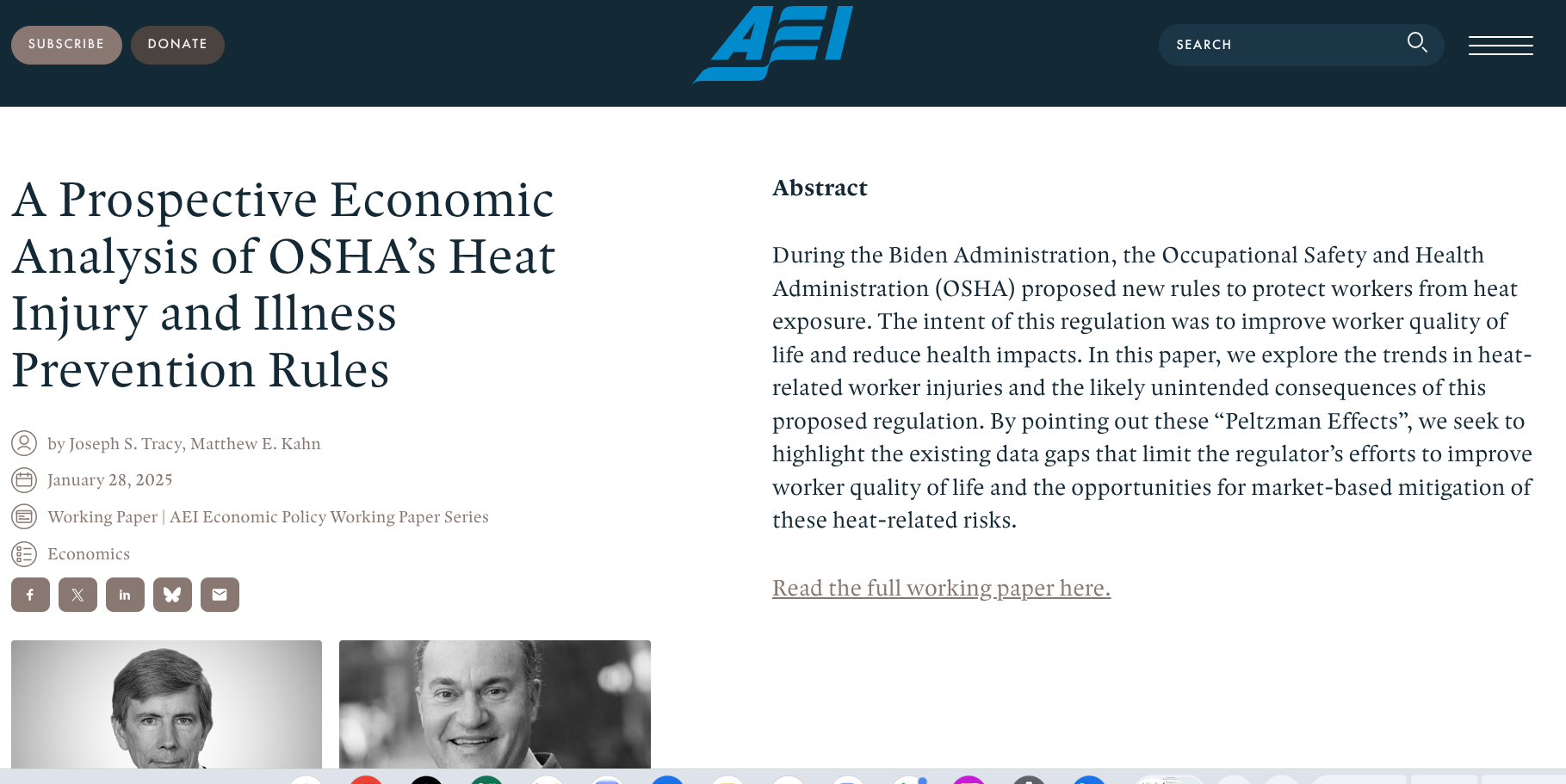
Back in January 2025, I co-authored a prospective piece that took a sober look at the Biden Administration’s proposed regulations. You can download a free copy of our paper here. After conducting this research, I opposed the Biden Administration’s proposed rules and I support the Trump Administration’s retreat on this issue. I will discuss these points below.
Here is our paper;
My summary of our paper focuses on classic heterogeneity issues. Workers differ with respect to their health conditions, risk preferences, desires to earn $ and their ability to “take the heat”. Workers have strong incentives to avoid jobs that expose them to too much heat and to take precautions to avoid heat exposure.
The Biden OSHA rules have a deep benevolent parternalism feel to them. The Biden Team assumes that all workers are naive about the health consequences of heat exposure and they are trapped in bad jobs and thus are exploited by employers. The “passive victims” hypothesis lurks throughout the OSHA documents praising the regulation.
In contrast, Sherwin Rosen taught us about equalizing wages. If a firm has a bad reputation for treating workers, then it will have to pay “combat pay” wage premiums and there will be constant turnover as workers quit or get sick.
The Biden OSHA team ignores the challenging identification problem of establishing Causality; are some workers sick due to a selection effect or a treatment effect (the heat) or a mixture of a selection effect and a treatment effect (the most vulnerable workers self select into the bad jobs and then get zapped with the heat). If regulations lead to some employers (especially small ones) reducing their hiring, does this help or hurt these vulnerable workers?
The Biden OSHA team ignores classic industrial organization issues of how the regulated industries will respond to this regulation. Will they cut back hiring? Will they substitute capital for labor?
Our paper also highlights the huge data gaps that OSHA faces. OSHA has terrible data at the firm/worker level to actually measure heat exposure for the workers being exposed to the heat. In this Big Data age, these data gaps are remarkable. Our paper discusses research designs to address this issue. Regulating under uncertainty is the wrong way to proceed with very costly regulation.
Here is Chat GPT’s summary of our paper;
Introduction
Main point: We argue that OSHA’s proposed heat standard should be evaluated using prospective economic analysis rather than simply accepting the agency’s regulatory impact assessment. We preview our central claim that the agency overstates the benefits of the rule while understating its costs because it pays insufficient attention to incentives, worker heterogeneity, and market adaptation.Government Regulation Is Unlikely to Have Caused the Long-Run Trend in Rising Worker Safety
Main point: We begin by placing OSHA’s proposal in historical context. Workplace safety has improved dramatically over many decades, but those improvements coincide with rising incomes, technological progress, better equipment, stronger employer incentives, and changing worker preferences. Our goal is not to deny that regulation matters, but to caution against attributing long-run safety improvements primarily to government mandates.Evaluating OSHA’s Annual Estimated Benefits
Main point: We carefully reconstruct OSHA’s benefit calculations and identify where we believe the agency’s assumptions are optimistic. Rather than accepting the agency’s estimates at face value, we ask whether the underlying empirical assumptions are supported by the available evidence.The Effectiveness of OSHA’s Proposed Regulations
Main point: Here we question whether the proposed regulation will actually produce the large reductions in injuries and fatalities that OSHA projects. In particular, we distinguish between average relationships observed in existing studies and the marginal effect of imposing an additional nationwide regulation on firms that are already taking many protective actions.The Value of Statistical Life and Injury Appropriate for OSHA
Main point: Even if the regulation reduces risk, the valuation of those risk reductions deserves careful scrutiny.
Value of Statistical Life: We argue that OSHA’s chosen VSL assumptions may not be the most appropriate for the population affected by occupational heat exposure.
Value of Statistical Injury: Likewise, we examine whether OSHA’s injury valuations and under-reporting adjustments are likely to overstate the true economic benefits.
Evaluating OSHA’s Annual Estimated Costs
Main point: We argue that the agency’s accounting of compliance costs is incomplete. Beyond the direct expenditures firms incur, the regulation may impose broader costs through reduced productivity, administrative burdens, and adjustments in labor markets that deserve greater attention in the benefit-cost analysis.A Microeconomic Analysis of the Likely Economic Impacts of the Proposed Regulation
Main point: This section develops the economic logic of the paper. We use standard labor-market economics to explain how the costs of regulation are likely to be shared among employers and workers, how employment and wages may adjust, and why incidence depends on market conditions rather than simply on who is legally required to comply.A More Cost-Effective Strategy for Protecting Vulnerable Workers
Main point: After critiquing the proposed rule, we offer constructive alternatives. Rather than relying primarily on broad mandates, we argue that targeted interventions—particularly those aimed at new workers, acclimatization, education, and the highest-risk occupations—are likely to generate greater safety improvements per dollar spent.A “Light Touch” Lower Cost Strategy for Protecting Vulnerable Workers
Main point: We conclude our policy analysis by outlining what we view as a more efficient role for government. OSHA can create substantial value by improving information, encouraging innovation, disseminating best practices, and reducing information frictions rather than relying exclusively on command-and-control regulation.Conclusion
Main point: We conclude that prospective regulatory analysis should be grounded in microeconomic reasoning and realistic behavioral assumptions. Our analysis suggests that OSHA’s proposed heat standard likely overstates net social benefits. We argue that a lighter-touch regulatory approach—one that complements rather than substitutes for private adaptation—would better protect workers while imposing lower economic costs.