

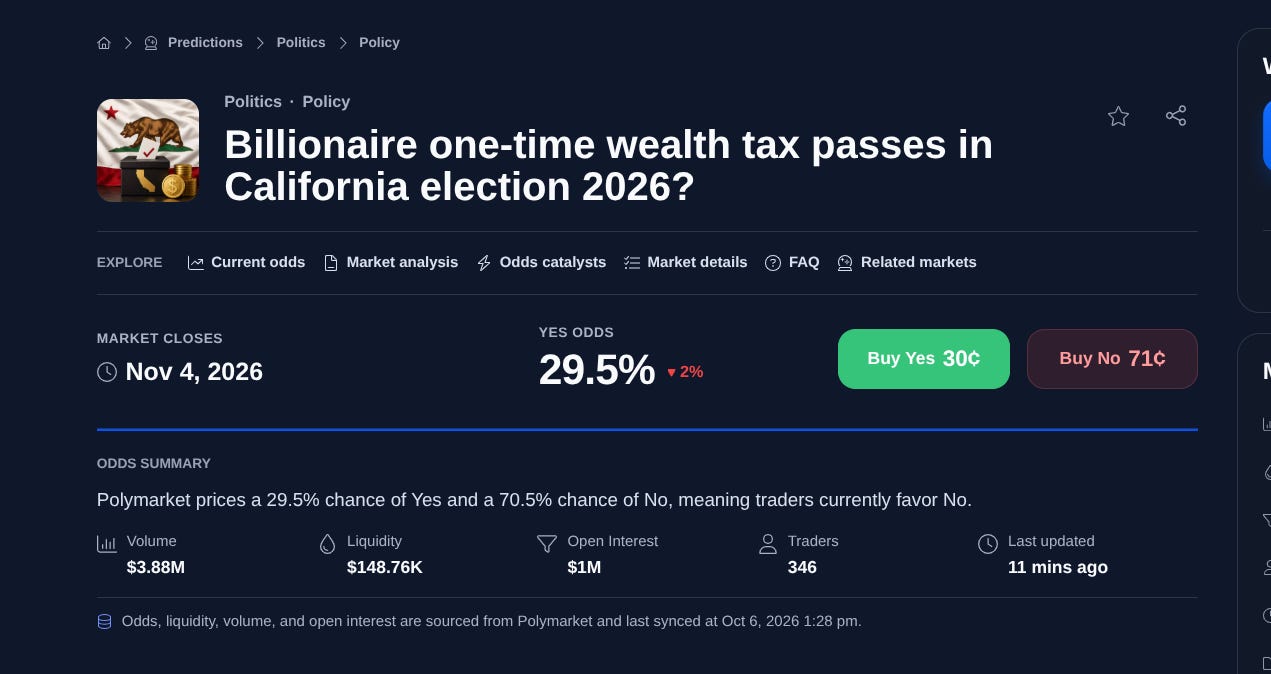
In early October 2026, the predicted probability that the 5% California Billionaire Wealth Tax will be enacted by voters in November 2026 is roughly 30%.
Joshua Rauh and his Hoover Team have done the leading applied policy research studying the likely unintended consequences of this policy proposal. Here are some links to Josh’s work on this subject.
Here I want to focus on a different issue. The year is now 2030 or 2040. Let’s explore two cases;
Case #1 Prop 40 fails to pass in November 2026.
How would a good statistician test if this policy’s mere proposal damages California’s economy? How could this happen? The policy proposal spooks wealthy people who are considering moving to California or remaining in California and they “take their talents” to Texas or Florida or somewhere else. Shifting expectations can be sufficient to shift the geography of where wealthy people live and work and if they tend to grow their business where they live then there is a multiplier effect here.
Since statisticians haven’t been gifted by God a California without Prop 40; what is the control group? In English, how do we predict the what -if pertaining to what would have been California’s growth path without the Prop 40 proposal?
A very talented MIT economist named Abadie has claimed that we can use “synthetic control” methods. Unlike with Darwin’s study of birds on islands, the U.S states form an integrated economy (and I will return to that point in a moment). Since , no other state is quite similar to California; we face an interesting statistical missing data problem that we seek to create a “Virgin California” from the other states that looks like California. So, suppose that California is 8% Jewish and 9% Korean. If Ohio is 4% Jewish and 18% Korean and Maine is 12% Jewish and 0% Korean then the synthetic control method would say that we mechanically construct California’s twin by looking at economic dynamics in “Fake California” = .5*Maine + .5*Ohio. This synthetic twin for California has similar Demographics at the baseline.
Suppose If Prop 40’s mere proposal leads wealthy people in California to move to other places because they expect that with this precedent case that soak the rich taxes are coming, then the cross-elasticity effect predicts that places like Ohio and Maine will be “treated” as some California wealthy people will move there. If they gain at the expense of California experiencing “expectations induced wealthy flight”, then the synthetic control before/after comparison understates the impact of the expected rising California tax on California’s economic prosperity. Why? The control group (Ohio and Maine thrived) because of the expectation of the California tax that didn’t even pass.
Why did Abadie design the synthetic approach? He argued that many states enact many policies and we face an apples and oranges issue comparing different states that enact different policies. He sought to prune the control set of states to have roughly similar states as the treated state (I.e California enacting the wealth tax). His linear algebra creates weighted combinations of states to create a control group.
Case #2 If the Prop 40 tax does pass
In this case, there are both the real effects that Josh Rauh’s team has documented and the expectations effect. By 2030 and 2040, these effects will start to materialize but how will researchers use a dynamic treatment/control framework to measure these?
A structural applied micro economist would model how firm birth, growth and death is affected for firms thinking of opening in California and elsewhere and also study how heterogeneous people choose where to live and spend their time. In an economy, where more people can engage in WFH with good airplane service; where do they spend their days? They can be in California 185 days a year without filing in my state. How price sensitive are these decisions?
California has unique quality of life but how much can you tax the “Golden Goose”? How do expectations for future taxes relate to tax propositions on the ballot today?
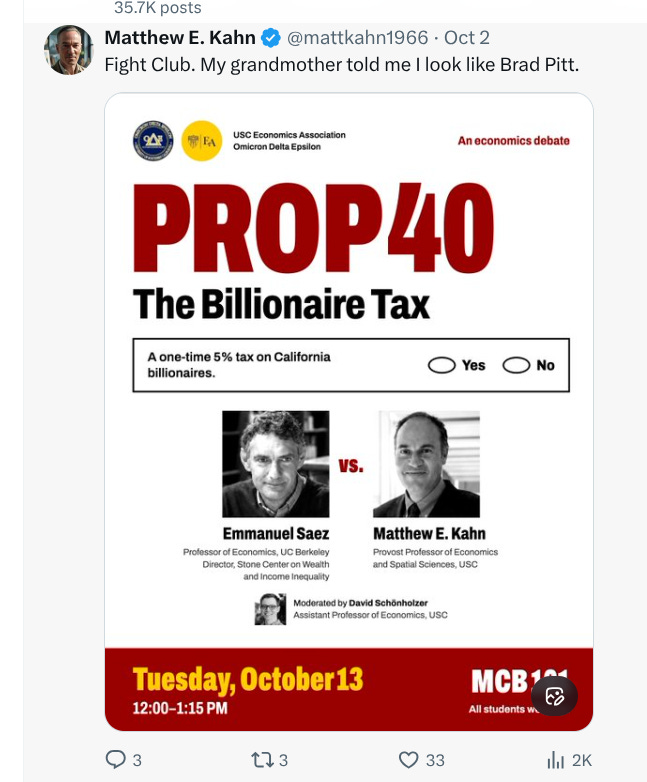
I am thinking about these points because I will be debating Prop 40 soon at USC.
I have 2 thoughts about making Donor Pool Selection easier.
(1)Try the international donor pool (e.g. Guangdong Province with HongKong and Macao, China + Texas, US + South Korea)
(2)Divide California into smaller parts and simulate them separately. Then combine them together according to their weights.
Regarding the synthetic control, Donor Pool selection is core challenge, as the outcome of billionaire tax cannot simply measured by straight variables like GDP per capita, and the natural amenity plus comprehensive economic comparative advantage are too unique.
Using Florida, Idaho, and Texas was my best optimized donor pool to simulate the Air Pollution of California without EV subsidy. I however admit that it's not rigorous enough.