
Will Date Drop Create Happy Young Power Couples?

My Wall Street Journal feed supplied some clickbait this morning.
Young people who opt in are asked to answer 66 questions in a quiz.
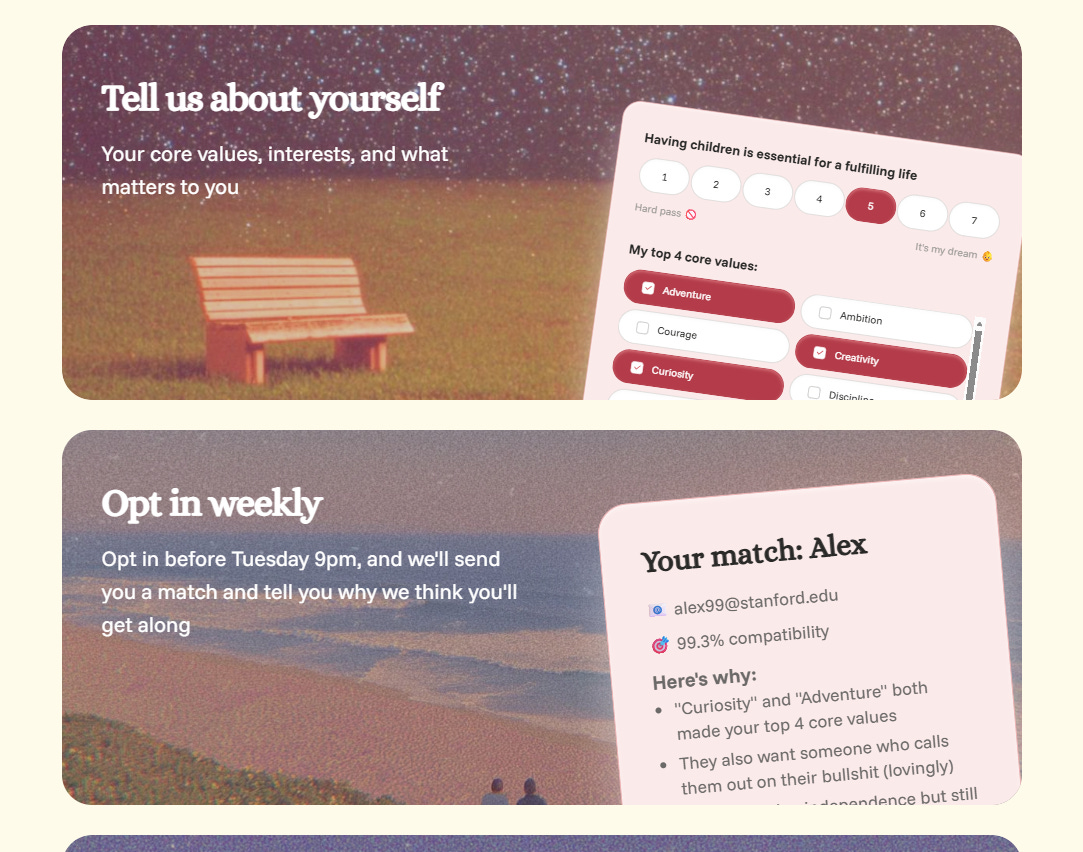
I am a married (old) economist and I will not be participating on this website. That said, I am intrigued.
On X, I posted my questions;
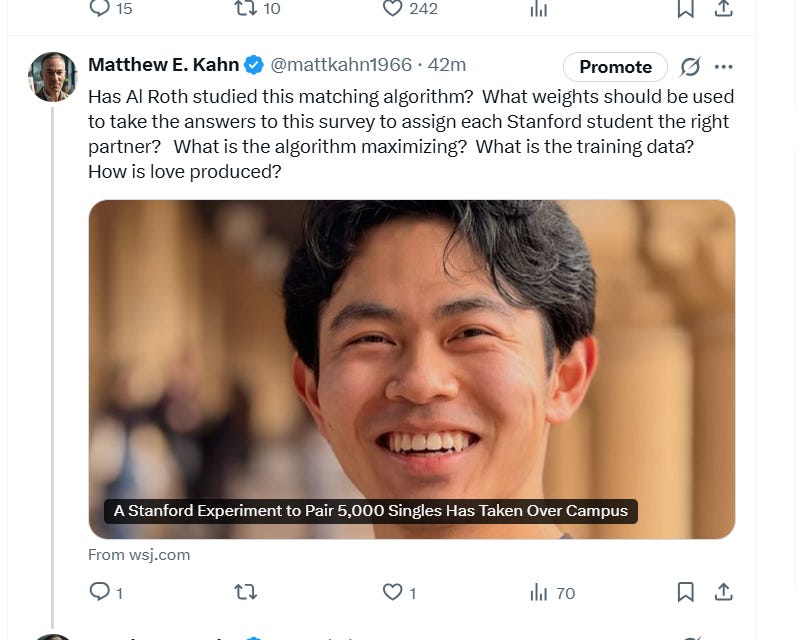
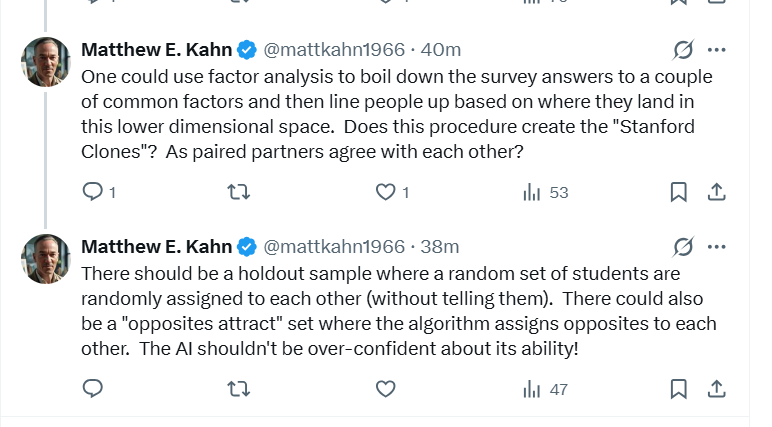
In this age of algorithms, what is the algorithm doing? What is the science of being a “good match”?
Now, I fully support this endeavor’s intent. We need more young people to be more optimistic about their future. They are more likely to be more optimistic if they fall in love. But, when do they meet the “right person”? Can this nudge achieve this goal and accelerate this search process?
In modern economics, there are many economists who have devoted their careers to studying job search; the process through which workers and firms are matched. It is claimed that AI firms accelerate this process.
Traditionally, different cultures have had “match makers” in the marriage and dating market. Can AI accelerate this process and improve the average quality of matches formed?
Unfortunately, I can’t access the 66 survey questions but I can guess what they say; “Do you have a poster of Greta T. or Barron Trump in your bedroom?” “What adjective do your friends use to describe you?” “Do you look forward to the campus nude midnight run?” “Do you call up your mother for advice?”
Each person on campus has a demographic profile (gender, race, height, major, out of classroom activities) and these 66 answers.
A mechanical algorithm can assign you a single number based on these and try to match you with “your twin”. Now, if you say that you believe that “opposites attract” then it may match you with your “evil twin”.
An index numbers problem arises. How does the algorithm choose weights on the various questions? Which of these questions really matter?
A good algorithm such as a finance trading strategy updates given its past performance. How does this App’s algorithm update? Do the couples that are formed report in on whether their relationship has survived for 3 weeks, 3 months, 3 years? Do they rate the quality of their relationship? If the App creates successful 1 month relationships, is that success?
Now, a good economist would ask; “what is the control group”? Here we need some randomization; we need some singles who participate in the dating App to be randomly assigned to another participant and then observe whether these randomly assigned couples are even more likely to become a Power Couple!
A good field experiment economist could think about other interventions here to learn the science of the chemistry of love!
Online dating firms have done a lot of research on this. I imagine they are using some of that evidence.